


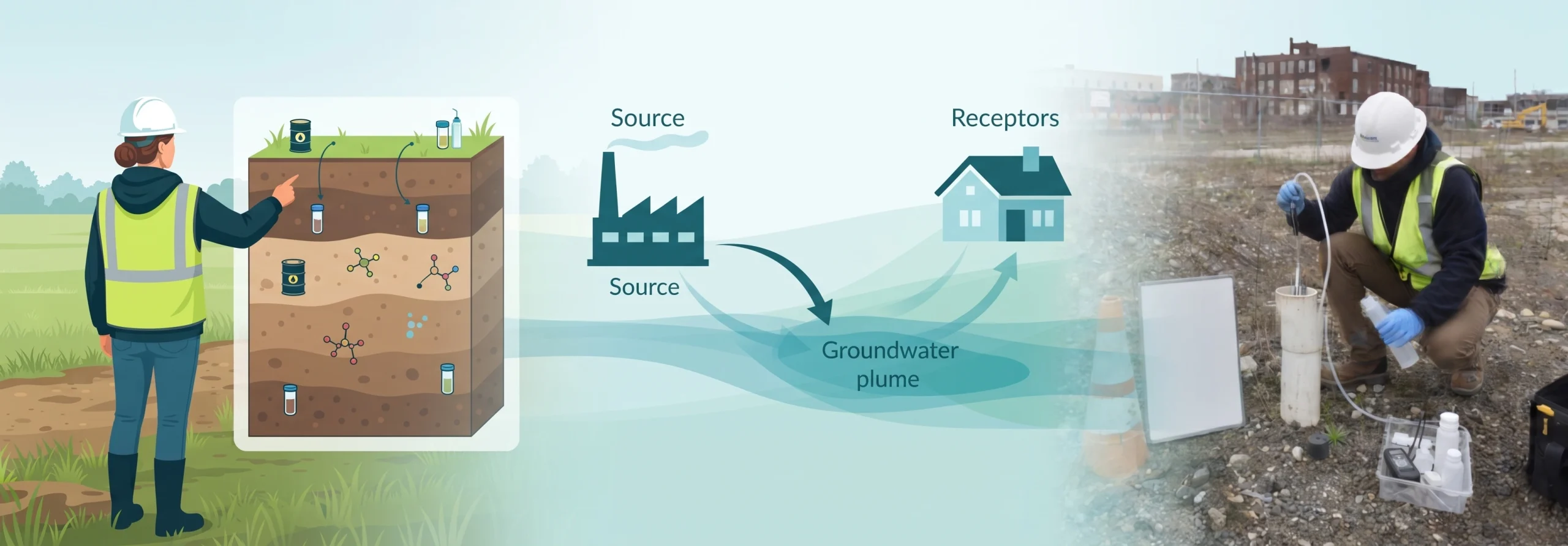
A contaminated site assessment typically includes records review, site reconnaissance, interviews, regulatory database checks, and, when warranted, physical sampling of environmental media. In the United States, Phase I ESA work is commonly tied to EPA’s All Appropriate Inquiries rule, and EPA recognizes ASTM E1527-21 for Phase I Environmental Site Assessments as consistent with that rule. (epa.gov)
In practical terms, the assessment asks four connected questions: what happened here, where could contamination be, who or what could be exposed, and what needs to happen next? A former dry cleaner, gas station, metal shop, agricultural property, or industrial parcel may raise different concerns than an office building or undeveloped lot. The assessment process helps separate assumptions from evidence so decisions are based on documented conditions rather than guesswork.
A strong pollution assessment also considers the future use of the property. A site planned for housing, a school, or a childcare facility may require a more conservative look at exposure than a paved commercial or industrial property. The same chemical concentration can mean different things depending on whether people might contact soil daily, inhale vapors indoors, drink affected groundwater, or disturb buried material during construction.
The risk assessment process turns data into decisions
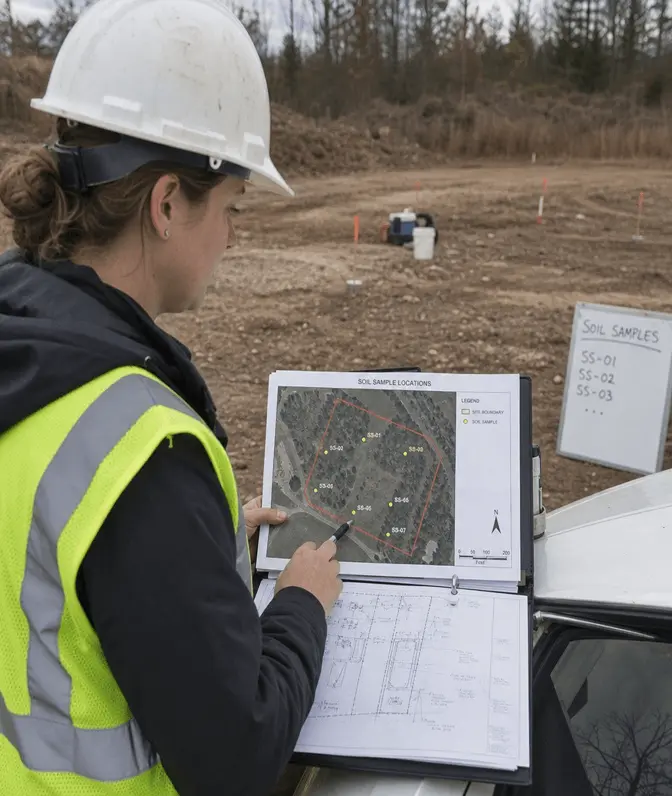
The risk assessment process is the bridge between investigation and action. It evaluates contaminants, concentrations, exposure pathways, receptors, and land use to determine whether conditions pose an unacceptable risk and whether controls or cleanup are needed.
A useful risk assessment does more than list laboratory results. It explains how contaminants could move through soil, groundwater, vapor, dust, stormwater, or sediment. It also identifies who could be affected, such as workers, residents, construction crews, nearby communities, ecological receptors, or future occupants. Regulators often expect this kind of pathway-based thinking because cleanup decisions need to be tied to actual exposure potential, not just the presence of a chemical.
Core elements usually include:
- Source identification: former tanks, spills, fill areas, waste handling zones, process areas, or off-site releases.
- Media evaluation: soil, groundwater, soil gas, indoor air, surface water, sediment, or building materials.
- Exposure pathways: direct contact, ingestion, inhalation, vapor intrusion, migration to groundwater, or ecological contact.
- Receptors: current users, future users, construction workers, nearby residents, and environmental resources.
- Decision points: no further action, additional investigation, risk management, removal, treatment, monitoring, or institutional controls.
EPA describes risk-based brownfield cleanups as a process that commonly includes site assessment, risk evaluation, cleanup option selection, implementation, and confirmation that the cleanup supports the intended reuse. (epa.gov) That sequence matters because redevelopment teams need both technical clarity and a defensible record of why a chosen remedy is appropriate.
Phase I ESA sets the direction
A Phase I ESA is a non-intrusive environmental assessment designed to identify recognized environmental conditions, often called RECs. It usually includes historical research, review of regulatory databases, site observations, interviews, and evaluation of adjoining or nearby properties that could affect the subject site.
Typical records reviewed may include historical aerial photographs, fire insurance maps, city directories, topographic maps, prior reports, building department files, tank records, spill databases, and hazardous materials records. The consultant also looks for visual clues during the site visit, such as stained pavement, vent pipes, fill areas, stressed vegetation, drums, sumps, floor drains, monitoring wells, or unusual odors.
The value of Phase I is that it helps determine whether a Phase II investigation is justified before money is spent on drilling, sampling, and laboratory analysis. If the Phase I finds no RECs and no major data gaps, the next step may be documentation and transaction support. If it identifies a former fuel station, dry cleaner, manufacturing operation, undocumented fill, or nearby plume concern, targeted testing may be the prudent next move.
For buyers and lenders, timing matters. Environmental due diligence is most useful before closing, lease execution, refinancing, or major redevelopment commitments. Waiting until after acquisition can reduce leverage, complicate financing, and leave the owner managing problems that could have been priced, insured, allocated, or avoided earlier.
When is Phase II contaminated land testing needed?
Phase II contaminated land testing is needed when Phase I findings suggest that hazardous substances or petroleum products may be present and the project team needs physical data to confirm, deny, or define the concern. It is also common when lenders, regulators, insurers, or redevelopment plans require more certainty before approving a transaction or construction plan.
Phase II is not a random sampling exercise. A good scope is built around the potential release areas identified in Phase I. For example, former underground storage tanks may require soil and groundwater borings near tank basins, dispensers, and piping runs. A former dry cleaner may require soil gas and groundwater sampling for chlorinated solvents. A former metal finishing operation may require soil testing for metals, pH-related impacts, and process chemicals.
Common field methods include:
- Soil borings and direct-push sampling to collect subsurface soil and screen conditions quickly.
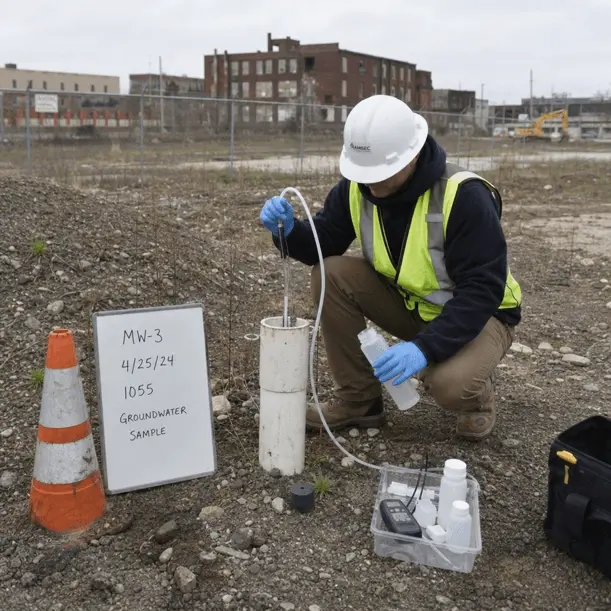
- Groundwater monitoring wells to evaluate dissolved contamination, flow direction, and plume behavior.
- Soil gas probes to assess vapor intrusion potential from volatile chemicals.
- Test pits or trenching where shallow fill, debris, or buried materials may be present.
- Surface water or sediment sampling where runoff, drainage channels, ponds, or wetlands may be affected.
Laboratory analysis may use methods such as gas chromatography, mass spectrometry, and metals analysis, depending on the contaminants of concern. Field screening tools can also help guide decisions while crews are on-site, but final conclusions usually rely on defensible analytical data, quality assurance, and comparison with applicable screening levels or cleanup standards.
Modern tools improve site characterization
Traditional sampling remains essential, but newer and higher-resolution tools can make site characterization more efficient. Direct-push technologies, membrane interface probes, laser-induced fluorescence for certain petroleum impacts, portable X-ray fluorescence for metals screening, and other field-based tools can help refine where contamination is likely to be concentrated.
These tools are most useful when they support a clear investigation strategy. For example, high-resolution screening can help identify a narrow source zone that would be missed by widely spaced borings. It can also reduce uncertainty before permanent monitoring wells are installed. That means the project team may be able to place wells, vapor probes, or confirmation samples more intelligently.
Still, technology does not replace professional judgment. Field readings need to be interpreted in context, calibrated where appropriate, and confirmed with laboratory data when decisions carry regulatory, legal, or financial consequences. The best results usually come from combining historical research, field observations, real-time screening, and certified laboratory analysis into one coherent conceptual site model.
California projects add regulatory complexity
A contaminated site assessment California project may involve state, regional, and local oversight depending on the property type, contaminants, water impacts, and redevelopment plan. The California Department of Toxic Substances Control’s Site Mitigation and Restoration Program oversees evaluation and cleanup of contaminated properties, including brownfields, voluntary agreements, State Superfund sites, school projects, military facilities, and corrective action matters. (dtsc.ca.gov)
California sites may also involve regional water boards, local oversight programs, air districts, city planning departments, or county environmental health agencies. This makes early regulatory strategy important. A site with petroleum impacts may follow a different path than one with chlorinated solvents, metals, pesticides, PCBs, or mixed industrial fill.
DTSC also emphasizes public understanding of risk assessment in the cleanup process, particularly because risk assessment evaluates potential health risk associated with cleanup alternatives rather than serving as a study of past health effects. (dtsc.ca.gov) That distinction is important for property owners and communities alike: the purpose is to support protective, forward-looking decisions.
If the project involves acquisition, redevelopment, grants, or public-facing reuse, the assessment should be planned with documentation in mind. Clear records of methods, assumptions, data gaps, and decision criteria can help reduce delays when agencies, lenders, or community stakeholders review the project.
Site remediation decisions depend on use and risk
Site remediation is not always the same as removing every detectable contaminant. In many cases, the objective is to reduce risk to acceptable levels for the intended use while meeting regulatory requirements and protecting long-term health and the environment.
Possible remedies include excavation and off-site disposal, in-situ treatment, soil vapor extraction, groundwater treatment, monitored natural attenuation, capping, vapor barriers, deed restrictions, engineering controls, or long-term monitoring. The right choice depends on contaminant type, depth, geology, groundwater conditions, building plans, schedule, cost, community concerns, and regulatory acceptance.
A practical remedy evaluation should consider:
- Effectiveness: Will it actually reduce exposure or contaminant mass?
- Implementability: Can it be built safely with available access, utilities, and site constraints?
- Permanence: Does it remove, destroy, contain, or simply manage contamination?
- Disruption: How will it affect neighbors, traffic, construction, dust, noise, and operations?
- Compliance: Does it align with applicable agency expectations and cleanup goals?
- Long-term responsibility: Will monitoring, maintenance, or land-use controls be required?
For developers, the best remediation plan is one that is integrated with design. A parking area, building slab, utility corridor, stormwater feature, or landscape plan may affect exposure pathways. Coordinating environmental, civil, geotechnical, and architectural decisions early can prevent costly redesign later.
Better assessment leads to better property decisions
A contaminated site assessment is most valuable when it is treated as decision support, not just a report. The findings can shape purchase negotiations, financing conditions, indemnities, insurance options, cleanup budgets, construction planning, and community communication.
Before starting, define the business question. Are you trying to satisfy lender due diligence, evaluate liability before closing, support a brownfield grant, prepare for redevelopment, respond to a regulatory request, or protect occupants? The answer affects the scope, schedule, sampling design, and level of documentation needed.
The strongest projects follow a simple pattern: investigate the history, test where evidence points, evaluate risk through realistic exposure pathways, and choose a remedy that fits the property’s future use. That approach helps avoid both underreacting to real hazards and overreacting to manageable conditions.
In the end, environmental uncertainty does not have to stop a project. With a disciplined risk assessment process, targeted contaminated land testing, and a clear remediation strategy, owners and project teams can move forward with better information, fewer surprises, and a stronger basis for protecting people, property, and the environment.