


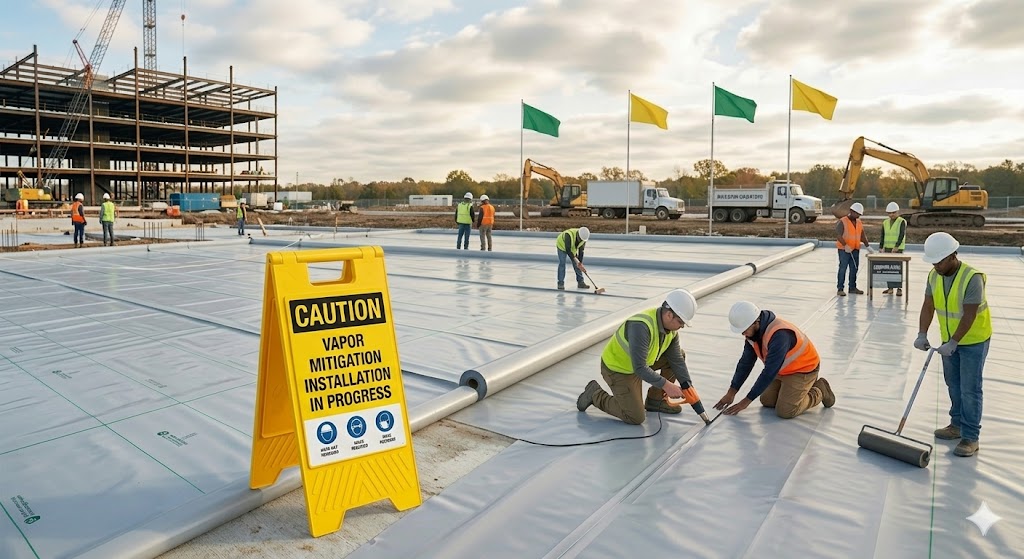
Environmental reports are not just lender requirements. They help identify risks that may affect the safety, value, financing, and future sale of a commercial property.
One important risk is vapor intrusion. This happens when chemical vapors from contaminated soil or groundwater move into a building through cracks, joints, drains, or utility openings.
A properly designed vapor barrier can help reduce these vapors before they enter the building. For developers, installing the system during construction is usually easier and more cost-effective than fixing the problem after the property is occupied.
Who Should Read This Guide?
This guide is useful for:
● Commercial real estate developers
● Property investors
● Lenders and underwriters
● Architects and contractors
● Owners developing industrial, urban, or previously contaminated sites
Environmental Glossary: Terms You Should Know
We believe in clear communication without confusing legal or scientific jargon. Here are the most common terms used during environmental site reviews across Texas and the United States:
● Vapor Intrusion: Toxic fumes from a nearby property are moving. They travel
directly through the soil. They actively drift onto your land. Think of it like
underground radon or bad sewer gas seeping into your home.
● ASTM E2600: This is an official national rulebook. Environmental professionals use this standard. They use it to check for vapor dangers. It tells us exactly how to screen a commercial property for chemical fumes.
● Vapor Encroachment: Toxic fumes from a nearby property are moving. They travel directly through the soil. They actively drift onto your land. For example, fumes from a neighboring gas station can drift underground toward your clean lot.
● Phase II ESA: This is a physical site test where experts take actual samples of the soil, groundwater, or soil gas. We use this deep testing when a Phase I report flags a potential pollution problem on your land.
● Sub-Slab Depressurization: This is a built-in fan and pipe system placed under a concrete floor to vent gases away. It acts like a vacuum cleaner that sucks up dangerous fumes and blows them safely outside before they reach the indoor air.
● EVOH Membrane: This is a highly advanced plastic liner. It is made of heavy-duty material. Workers install it directly underneath a building’s concrete slab. It contains a specialized chemical layer that blocks toxic vapors much better than regular plastic sheets.
● Chlorinated Solvents: These are harsh, man-made chemicals. People often use them to degrease metal parts. Companies also use them to clean clothes at dry cleaners. These heavy chemicals last a very long time in the soil and turn into dangerous gases easily.
The Impact on Underwriting and Property Insurance
A proactive vapor mitigation strategy is often the “hidden key” to favorable financing and insurance terms. Insurance companies and lenders are paying much closer attention to vapor risks. They now look at vapor encroachment as a major, separate danger. To evaluate this threat, they follow a specific set of rules known as the ASTM E2600 standard.
Environmental Liability & Risk Transfer:
A certified vapor barrier acts like a real warranty. It guarantees your building is safe from
fumes. It gives you physical proof. It shows your property is safe.
It provides solid engineering control. This cuts the risk of future legal claims. This makes it
easier to get specialized insurance. It helps you quickly secure environmental and pollution
coverage
Having a certified barrier makes selling your property much easier. Large buyers and banks
prefer safe deals.
They want the vapor problem permanently fixed before they buy it. It gives them confidence
because it eliminates future legal and environmental risks.
Securing the Exit Strategy:
Having a certified barrier makes selling your property much easier. Large buyers and banks
prefer safe deals.
They want the vapor problem permanently fixed before they buy it. It gives them confidence
because it eliminates future legal and environmental risks.
What Is Vapor Intrusion?
Vapor intrusion occurs when chemicals beneath or near a property release fumes that travel
through the soil and enter indoor spaces.
Common sources include:
● Former gas stations
● Dry-cleaning facilities
● Industrial properties
● Underground storage tanks
● Petroleum contamination
● Chlorinated solvents
The risk depends on the type of chemical, contamination levels, soil conditions, building
design, and distance from the source.
What Is a Vapor Barrier?
A vapor barrier is a protective membrane installed beneath a building’s concrete slab. It reduces the movement of chemical vapors into the property.
A vapor barrier for concrete may be installed with:
● Sealed seams and edges
● Pipe and utility penetration seals
● Passive venting
● Monitoring points
● Sub-slab depressurization systems
The correct system should be selected according to the chemicals found on the property.
Vapor Barrier Insulation vs Chemical Vapor Barriers
The term vapor barrier insulation often refers to moisture protection used in walls, roofs, or foundations.
A chemical vapor barrier is different. It is designed to block harmful vapors linked to soil or groundwater contamination.
A standard plastic moisture barrier may not provide enough protection against petroleum vapors or chlorinated solvents. Developers should confirm that the selected membrane is suitable for the specific chemicals identified during environmental testing.
How Phase I and Phase II ESAs Relate to Vapor Barriers
A Phase I ESA vapor barrier decision usually begins with an environmental site
assessment.
A Phase I ESA reviews:
● Historical property uses
● Environmental records
● Nearby contaminated sites
● Current site conditions
● Potential sources of pollution
A Phase I ESA normally does not include physical testing. However, it may identify conditions that require further investigation.
If vapor concerns are found, a Phase II ESA may be recommended. A Phase II ESA vapor barrier evaluation may include testing:
● Soil
● Groundwater
● Soil gas
● Sub-slab vapor
● Indoor air
The findings help determine whether a vapor barrier, ventilation system, active mitigation system, or additional cleanup is required.
Phase I/II ESA Vapor Barrier Process
A typical Phase I/II ESA vapor barrier process includes:
1. Completing a Phase I ESA
2.Identifying possible vapor sources
3. Conducting Phase II sampling when needed
4. Evaluating the vapor intrusion pathway
5. Designing the mitigation system
6. Completing vapor barrier installation
7. Inspecting and testing the membrane
8. Keeping installation and environmental records
This process helps ensure that the mitigation system matches the actual conditions beneath the property.
Vapor Barrier Installation
Proper vapor barrier installation is essential. Even a strong membrane can fail if seams, edges, or pipe openings are not sealed correctly.
Installation should include:
● Preparing a smooth subgrade
● Removing sharp debris
● Sealing all overlaps
● Protecting utility penetrations
● Repairing punctures
● Inspecting the membrane before concrete is poured
● Recording the installation with photographs and reports
The vapor barrier should also be protected from construction traffic and damage during reinforcement and slab placement.
Vapor Barrier Installation
Proper vapor barrier installation is essential. Even a strong membrane can fail if seams, edges, or pipe openings are not sealed correctly.
Installation should include:
● Preparing a smooth subgrade
● Removing sharp debris
● Sealing all overlaps
● Protecting utility penetrations
● Repairing punctures
● Inspecting the membrane before concrete is poured
● Recording the installation with photographs and reports
The vapor barrier should also be protected from construction traffic and damage during reinforcement and slab placement.
Why Proactive Installation is the Only Choice
The financial delta between proactive and reactive mitigation is stark. In the context of
project deliveries, waiting to “see if it’s an issue” is a high-stakes gamble.
● The Proactive Path: Putting in a strong chemical vapor barrier during construction is
easy to plan for. It is a steady, manageable line item in your project budget. You can
choose a spray-applied version or an EVOH membrane to keep the site safe.
● The Reactive Path: Finding vapor problems after people move in is a major headache. It causes huge disruptions for everyone in the building.
To fix it, you must use a sub-slab depressurization system. This means drilling holes into your nice floors. You also have to install large pipe manifolds.
This causes massive disruption for your tenants. It typically costs 5 to 10 times more than installing it during construction. Integrating Mitigation into Project Deliveries Building on impacted properties depends on a clear, step-by-step plan. First, your Phase II environmental assessment finds the underground issues. Next, you must quickly turn those findings into active engineering fixes on the job site.
● Technical Precision: The vapor barrier you choose must match the exact chemicals found on your property.
Different hazards need different barriers. For example, chlorinated solvents need one type. Petroleum fuels need a completely different type.
Your Phase II report will tell you exactly which chemicals of concern are in the ground.
● Quality Assurance: To make sure the barrier works perfectly, it needs a third-party
inspection. Workers should perform a smoke test before pouring the concrete slab.
This test gives the developer “Clean Hands” documentation to protect against future
legal claims.
Impact on Financing and Insurance
Lenders and insurers may review vapor risks because contamination can affect:
● Occupant safety
● Property value
● Construction costs
● Environmental liability
● Loan approval
● Insurance coverage
● Future resale
A documented mitigation strategy can show how the risk is being managed.
Useful records include:
● Phase I and Phase II ESA reports
● Vapor testing results
● Mitigation designs
● Product specifications
● Installation photographs
● Inspection reports
● Maintenance plans
A vapor barrier does not completely remove environmental liability, but it can provide an
important engineering control.
Standards and Guidance
Environmental professionals may consider several standards and regulations when evaluating vapor risk.
These may include:
● ASTM E2600 for vapor encroachment screening
● EPA vapor intrusion guidance
● State environmental regulations
● TCEQ requirements for properties in Texas
The exact requirements depend on the property location, contamination, and intended use.
Our team follows strict national rules. These guidelines protect your commercial real estate. We track federal EPA rules. We also track local state laws. These steps ensure complete safety. It keeps your project in full compliance. In Texas, we follow TCEQ standards closely. We make sure your building design aligns perfectly with state-specific cleanup and defense goals. Our nationwide network also coordinates with environmental agencies across all 50 states. We use these rules to cut through government red tape anywhere in the country.
Frequently Asked Questions
Vapor intrusion occurs when chemical fumes from contaminated soil or groundwater enter a
building.
A Phase I ESA may identify former property uses or nearby contamination that could create
vapor concerns. Further testing may still be needed.
A vapor barrier should be considered when environmental testing or site history shows that
chemical vapors may affect a proposed building
Not always. Some properties may also require passive venting, sub-slab depressurization,
monitoring, or additional cleanup.
ASTM E2600 is a guide used to screen commercial properties for potential vapor
encroachment risks.
Yes. Existing buildings may be treated using ventilation, sealing, or sub-slab depressurization
systems, although the work may be more disruptive.
The buyer may request additional testing, negotiate the purchase price, require cleanup,
redesign the project, or install a mitigation system.
Next Steps
Developers should address vapor concerns before foundation construction begins.
Start by reviewing the Phase I ESA. If vapor risks are identified, complete the necessary
Phase II testing and work with qualified professionals to select the right mitigation system.
Early planning can help protect occupants, reduce delays, support financing, and preserve the
property’s long-term value.
Protect Your Project Before Construction Begins
A properly designed vapor barrier can help reduce environmental risk and support the safe development of a commercial property.
Contact our environmental team for Phase I and Phase II ESA services, vapor-risk evaluation, mitigation planning, and vapor barrier installation support.