


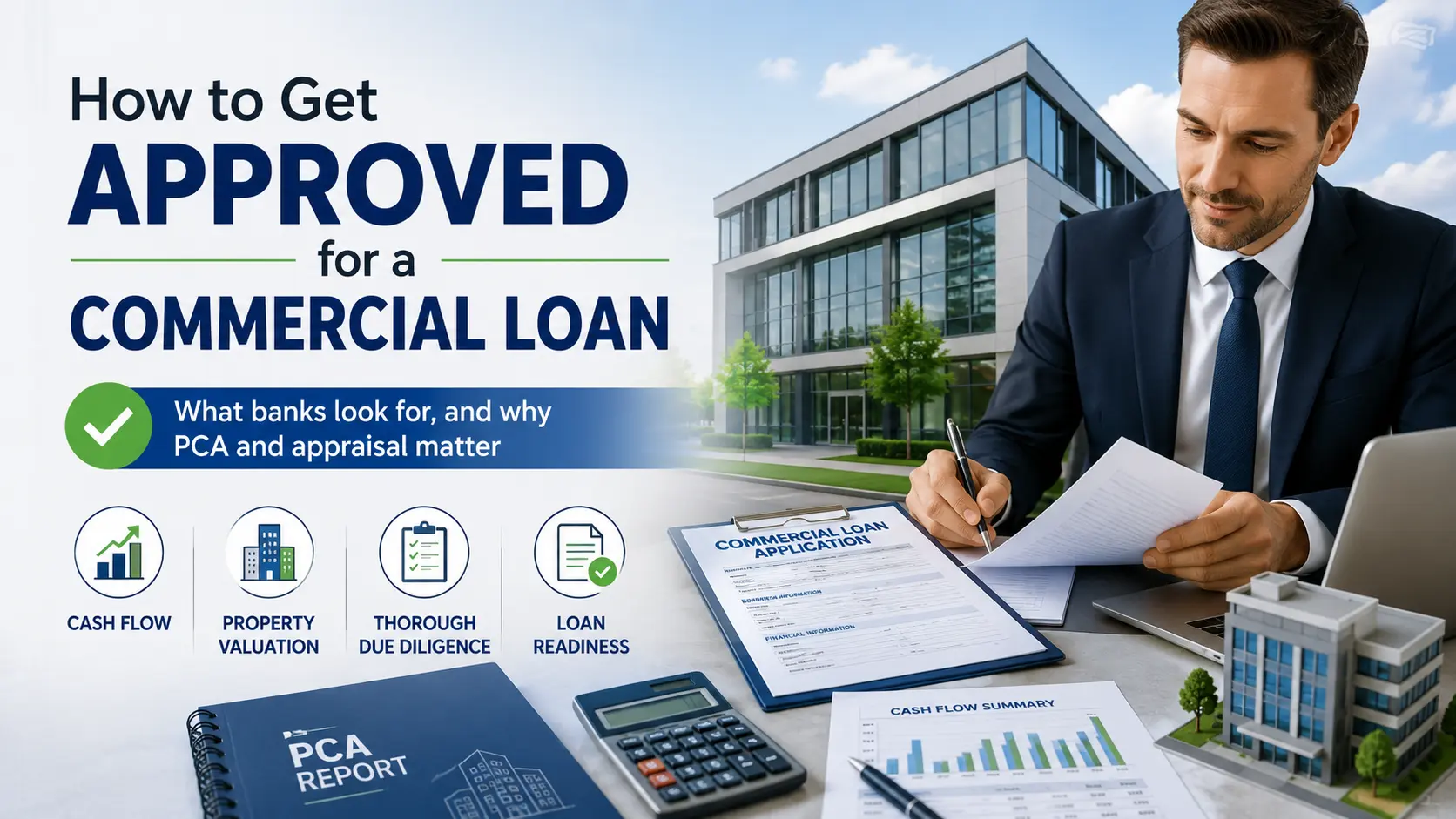
Buying a commercial property is a huge milestone for your business or your investment portfolio. But if you need a bank loan to buy it, you must pass the bank’s test first.
Getting a commercial mortgage is very different from getting a regular house loan. Banks are much stricter because a lot more money is on the line.
If you want your loan approved quickly, you need to know exactly what the bank is looking for. You also need to know about two important people who will inspect the building. One checks the property’s physical condition, while the other figures out its dollar value.
Let’s break down exactly how this works in plain English.
Part 1: What Does a Bank Look for in a Commercial Loan?
When you apply for a commercial loan, the bank has just one big question: “If we lend you this money, will you pay it back?”
To figure that out, banks look closely at three main things. You can think of these as the pillars of a commercial loan.
1. The Cash Flow (The Property’s Income)
For residential homes, banks look at your personal salary. For commercial buildings, banks care most about the money the building itself makes.
- If you are buying an apartment building, office space, or a strip mall, the bank wants to see the rent checks coming in from tenants.
- They use a math formula called the Debt Service Coverage Ratio (DSCR). In simple terms, the bank wants the property’s net income to be at least 20% to 25% higher than the monthly loan payment. This gives everyone a safe buffer.
2. Your Business and Personal Financial Health
Even if the building makes money, the bank still looks at you. They will check:
- Your credit score: A good personal and business credit score proves you pay your debts on time.
- Your experience: Banks love working with people who know what they are doing. If you have run a successful business or managed properties for at least two years, the bank will feel much safer.
- Your down payment: Be ready to put some skin in the game. While home loans sometimes allow tiny down payments, commercial loans usually require you to pay 15% to 35% of the purchase price upfront in cash.
3. The Property Itself (The Collateral)
Collateral is the bank’s safety net. If something goes wrong and you stop paying the loan, the bank will take the building and sell it to get their money back. Because of this, the bank needs to know exactly what the building is worth and what physical shape it is in.
This brings us to the experts who inspect the property.

Part 2: What is a Property Condition Assessment (PCA)?
Before lending you money for a building, the bank will usually ask for a detailed structural inspection, called a PCA .
A PCA is basically a mega-inspection of a commercial building.
Think of it like taking a used car to a master mechanic before you buy it. You don’t just want to know if the paint looks shiny; you want to know if the engine is about to explode.
A team of licensed inspectors or engineers will walk through the property and check out every single major system, including:
- The Structure: Is the foundation cracking? Are the walls safe?
- The Roof: Is it leaking, or will it need to be replaced next year?
- The Mechanical Systems: How are the heating, cooling (HVAC), and plumbing systems running?
- The Electrical System: Is the wiring up to modern safety codes?
The Two Most Important Parts of a PCA Report
Once the inspection is done, you receive a massive document. You should flip straight to two specific tables:
- The Immediate Repairs Table: This lists everything that is broken right now and must be fixed immediately for safety or legal reasons.
- The Replacement Reserve Table: This is a financial crystal ball. It tells you how long major items (like the roof or elevator) will last, and how much money you need to save over the next 10 to 12 years to replace them.
Why this matters: If the inspection shows the roof needs a $50,000 fix, you can ask the seller to lower the price.
Part 3: PCA vs. Bank Assessor (What Is the Difference?)
Many first-time buyers get confused here. They think, “The bank is sending an assessor to look at the property, so why do I need a PCA too?”
While both professionals visit the property, they have completely different jobs. An assessor (often called a commercial property appraiser) looks at value, while a PCA inspector looks at condition.
Here is a simple table to see how they differ side-by-side:
The Property Condition Assessment (PCA)
The PCA team checks the physical health of the building. They work for you and the bank to make sure you aren’t buying a broken property.
The inspectors look at real things like roofs, plumbing, electrical wires, and foundations.
Their main question is: “Are there hidden physical problems that will cost a fortune to repair?”
The Bank Assessor (Appraiser)
The bank assessor figures out the dollar value of the building. They are hired directly by the bank to make sure the property is actually worth the amount of the loan.
The assessor looks at numbers, like recent sales of nearby buildings, local neighborhood trends, and rental income.
Their main question is: “If the bank has to sell this building tomorrow, how much cash will it get?”
How They Work Together
Imagine you are buying a retail building for $1 million.
The Bank Assessor looks at nearby properties and confirms, “Yes, this building is worth $1 million in the current market.” The bank breathes a sigh of relief.
But then, the PCA Inspector crawls onto the roof and notes, “The air conditioning units are rusted out and the roof is rotting. It will cost $100,000 to fix this.”
Because of the PCA report, the bank now knows the building isn’t truly worth $1 million in its current state. They might tell you they will only approve the loan if the seller fixes the issues or drops the price.
Final Thoughts for Buyers
Navigating a commercial property purchase can feel overwhelming, but it gets much easier when you know what the bank wants.
To set yourself up for success, keep three simple rules in mind:
First, keep your financial paperwork organized.
Second, make sure the building is capable of making good money.
Finally, never skip the property inspection.
A PCA might cost some money upfront, but it is the best tool you have to protect your investment and prove to the bank that your new building is a safe bet.