



In the high-stakes world of commercial real estate and corporate acquisitions, due diligence checklists are often dominated by environmental reports, zoning laws, and financial audits.
However, an increasingly critical—and often overlooked—component is compliance with the Americans with Disabilities Act (ADA). Failing to identify ADA violations during the due diligence phase can lead to astronomical remediation costs, legal battles, and significant brand damage post-acquisition.
Who Should Read This Guide?
This guide is useful for:
● Commercial property buyers
● Real estate investors
● Developers
● Lenders and underwriters
● Property managers
● Asset managers
● Companies involved in acquisitions or redevelopment
Anyone evaluating a commercial property should consider ADA compliance in real estate due diligence alongside environmental, structural, financial, and zoning reviews.
Why ADA Compliance Matters During Due Diligence
Accessibility concerns can affect more than the usability of a property. They may also influence renovation costs, transaction negotiations, future improvements, and overall risk.
A property that appears well maintained may still contain accessibility barriers that are not obvious during a standard walkthrough.
Examples can include improperly designed parking areas, inaccessible entrances, narrow routes, unsuitable restroom layouts, or missing accessibility features.
Identifying these issues before closing gives buyers a better understanding of possible future expenses.
Physical Barriers and “Readily Achievable” Barrier Removal
The ADA requires that “public accommodations” remove architectural barriers in existing facilities when such removal is “readily achievable”—meaning it can be accomplished without much difficulty or expense.
During due diligence, buyers must assess whether the property meets current 2010 ADA Standards for Accessible Design.
Common physical issues identified during inspections include:
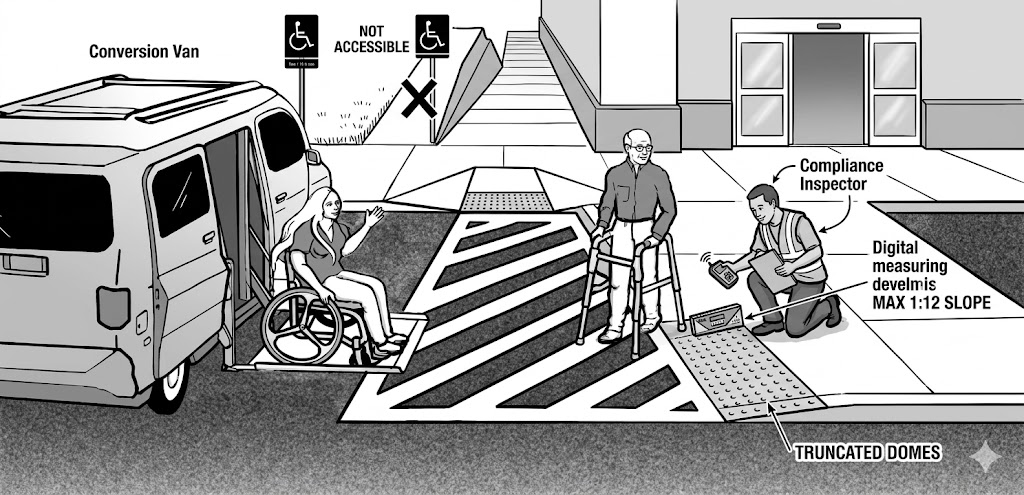
● Parking: Non-compliant parking space dimensions or missing “van-accessible” signage.
● Path of Travel: Improper ramp slopes or lack of level landings.
● Restrooms: Fixtures that lack proper clearance or grab bars installed at incorrect heights.
If a buyer assumes ownership of a non-compliant building, they inherit the legal obligation to fix these issues, regardless of whether the previous owner was ever cited.
What Does an ADA Compliance Review Look At?
An accessibility review may focus on visible features that affect how people enter, move through, and use a property.
Depending on the building and scope, a review may consider:
● Accessible parking
● Passenger loading areas
● Building entrances
● Routes through common areas
● Ramps and stairs
● Door clearances
● Restrooms
● Signage
● Service counters
● Common-use spaces
The purpose is to identify visible barriers that may require additional attention.
Working with an ADA compliance consultant can help property stakeholders better understand where accessibility concerns exist and which areas may require further evaluation or improvement.
Mitigating Risk Through Physical Surveys
To protect your investment, ADA compliance should be integrated into the early stages of due diligence. This involves hiring specialized consultants to perform inspections or physical surveys.
Furthermore, purchase agreements should include specific representations and warranties regarding ADA compliance, potentially backed by indemnification clauses or price adjustments if significant barriers are discovered.
By addressing these issues before the ink is dry, investors can ensure that their new asset is truly accessible to everyone—and shielded from unnecessary litigation.
How an ADA Compliance Expert Supports Property Buyers
An ADA compliance expert can help buyers identify visible accessibility concerns before they become larger operational or financial problems.
The goal is not simply to create a list of deficiencies. A useful review should help stakeholders understand which conditions deserve attention and how those findings may affect future planning.
This information can be useful when:
● Estimating renovation budgets
● Planning property upgrades
● Reviewing capital expenses
● Negotiating purchase terms
● Prioritizing corrective work
● Evaluating overall property risk
Accessibility findings can also be reviewed alongside a Property Condition Assessment so buyers have a broader understanding of the building.
Choosing Between ADA Compliance Companies
Not all ADA compliance companies offer the same scope of services.
When comparing providers, buyers should look beyond price and consider the consultant’s experience with commercial properties, reporting quality, inspection scope, and ability to clearly document visible concerns.
A useful report should explain where potential accessibility barriers were observed and provide enough information for the property team to determine appropriate next steps.
For larger or more complex buildings, the scope may also need to reflect the property type, age, layout, and intended future use.
ADA Compliance Florida: Why Location Still Matters
Businesses searching for ADA compliance Florida services should remember that accessibility reviews may involve both federal ADA requirements and other requirements that apply to the specific property location.
The same principle applies in other states.
Commercial property owners should make sure the consultant understands the location of the property and the scope of the due diligence review.
For investors operating across several states, this becomes especially important because properties may have different layouts, uses, and local requirements.
Pro Tip:
Don’t rely on a building’s “Certificate of Occupancy” as proof of ADA compliance. Local building codes and federal ADA requirements are distinct; a building can be “code legal” but still violate federal civil rights law.
When Should ADA Compliance Be Reviewed?
Accessibility should ideally be considered early in the due diligence process.
A review may be useful when:
● Purchasing a commercial building
● Financing or refinancing a property
● Planning renovations
● Redeveloping an older building
● Acquiring a large property portfolio
● Changing how a building will be used
● Preparing a long-term capital plan
Early review gives buyers more time to investigate concerns and include potential improvement costs in their financial planning.
How SKA Environment Can Help
SKA Environment can help commercial property buyers, owners, investors, and lenders identify visible accessibility concerns as part of broader property due diligence.
A professional review can help stakeholders:
● Identify potential accessibility barriers
● Document visible site conditions
● Understand areas that may require further evaluation
● Plan future improvements
● Include accessibility concerns in transaction decisions
● Reduce unexpected post-acquisition costs
By reviewing accessibility alongside other property conditions, SKA Environment helps clients develop a clearer picture of potential building risks before making major financial decisions.
Buying, financing, or evaluating a commercial property? Contact SKA Environment to discuss your due diligence needs.
ADA Compliance in Due Diligence: Frequently Asked Questions
Accessibility issues may require future modifications or repairs. Identifying them before purchase can help buyers understand possible costs and risks.
Reviews may include parking areas, entrances, accessible routes, ramps, doors, restrooms, signage, and other common-use areas.
A vapor barrier should be considered when environmental testing or site history shows that
chemical vapors may affect a proposed building
Yes. Accessibility concerns can be reviewed alongside Property Condition Assessments and other physical due diligence services.
A consultant can help identify visible accessibility barriers and provide clearer documentation for buyers, owners, and property managers.
No. A Certificate of Occupancy does not automatically establish compliance with all federal accessibility requirements.
Final Takeaway
ADA compliance can easily be overlooked when buyers are focused on financial, environmental, and structural risks.
However, accessibility concerns can create future costs and complications if they are not identified early.
Including ADA compliance in real estate due diligence gives buyers a more complete understanding of the property before closing. A professional review can help uncover visible barriers, support better budgeting, and reduce unexpected issues after acquisition.
For commercial real estate investors, accessibility should be treated as an important part of responsible property due diligence—not an afterthought.