


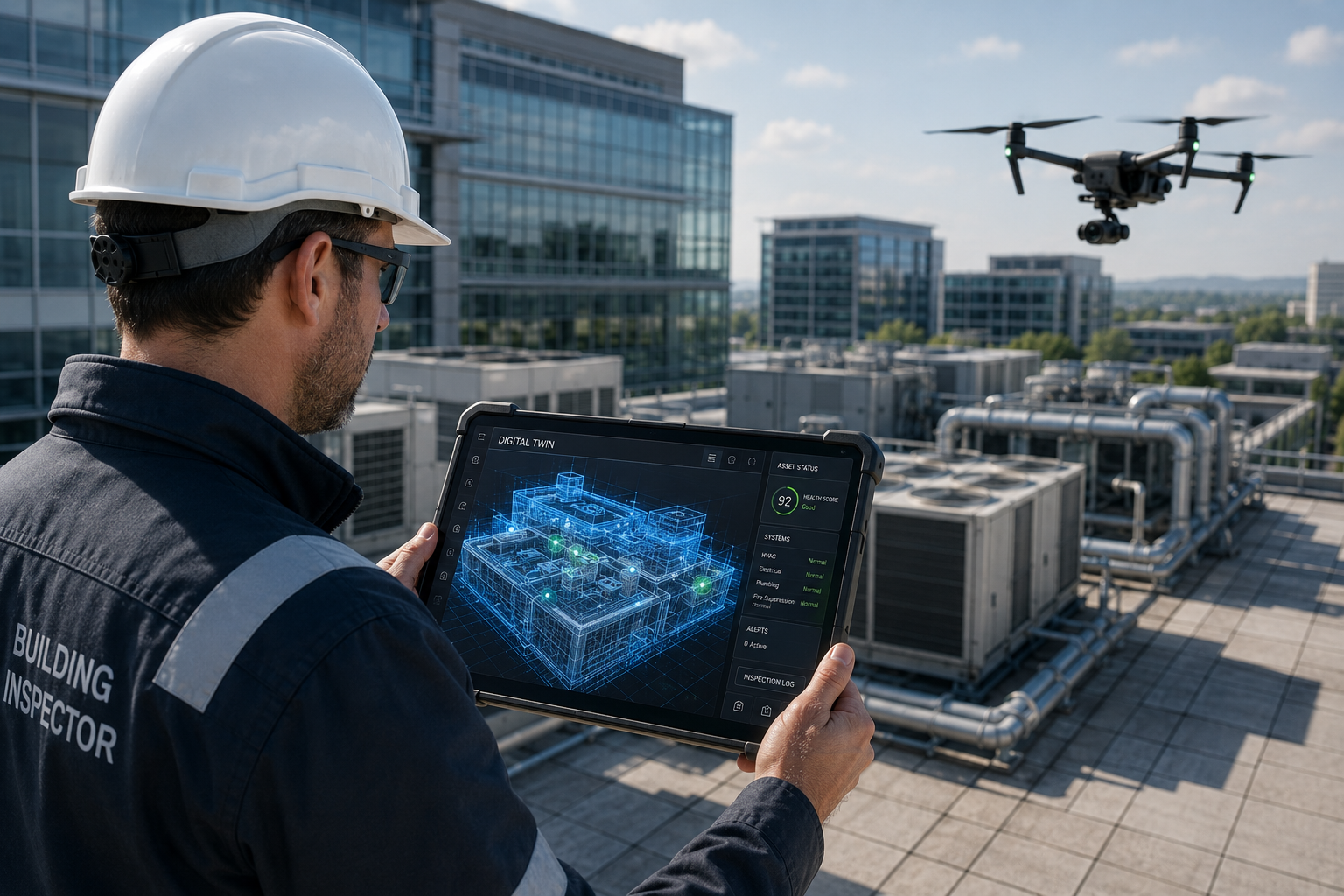
Drone Property Condition Assessment
For decades, the commercial real estate (CRE) industry has relied on a foundational document to mitigate transactional risk: the Property Condition Assessment (PCA). Historically, this was a highly manual, analog exercise. An engineer or architect would walk a site, clipboard and digital camera in hand, noting visual deficiencies, estimating the remaining useful life (RUL) of critical components, and snapping hundreds of static photos. The resulting Property Condition Report (PCR)—a massive PDF thick with dense tables and a generic 10-to-20-year capital expenditure (CapEx) forecast—was essential for compliance, but it was essentially a static snapshot of a building frozen in time.
Today, the commercial real estate landscape is undergoing a massive paradigm shift. Driven by exponential advances in artificial intelligence (AI), computer vision, sensor technology, and spatial computing, the PCA is evolving from a point-in-time diagnostic report into a dynamic, continuous, and predictive asset management ecosystem.
While the average inspector might still rely on traditional manual tools, a distinct frontier of tech-enabled engineering firms is pushing the industry forward. For investors, lenders, and facility managers, understanding this technological leap is no longer optional—it is the new baseline for protecting capital and maximizing asset value.
Who Should Read This Blog?
This blog is helpful for commercial property owners, investors, developers, lenders, asset managers, and facility managers. It is also relevant for anyone involved in commercial real estate transactions, building maintenance, due diligence, or long-term capital planning.
Readers who want to understand how drones, artificial intelligence, Digital Twins, and sensor technology are changing Property Condition Assessments will find this guide particularly useful.
From Eyeballs to Algorithms: The Data Acquisition Revolution
The first stage of this evolution is happening on site. The ‘walkthrough’ is being replaced by systematic digital data capture. Instead of an engineer spending days scaling a roof or logging HVAC serial numbers, technology now handles the heavy lifting, improving safety and precision.
High-Flying Data Capture
Drone technology has completely revolutionized building envelope and roof inspections. Armed with high-resolution optical and thermal cameras, a drone can autonomously map a multi-acre industrial roof in a fraction of the time it takes a human inspector.
More importantly, thermal imaging captures what the human eye cannot: sub-surface moisture trapped within roof insulation. Because water retains heat longer than dry roofing material, thermal sensors reveal distinct temperature differentials after sunset. This allows inspectors to pinpoint precise leaks and localized degradation, turning what used to be an expensive “guess-and-replace” roof quote into a targeted, low-cost patch repair.
Computer Vision and Automated Defect Recognition
The true power of modern data acquisition isn’t just capturing imagery; it is how that imagery is analyzed. When thousands of high-definition photos or drone scans are uploaded to the cloud, AI algorithms—trained on millions of square feet of structural data—take over.
Using computer vision, the AI automatically detects, categorizes, and measures defects. For instance, the software can instantly flag every hairline crack in a concrete facade, map pavement distress patterns (like alligator cracking) across a parking lot, or identify rusted structural steel.
By removing human subjectivity and fatigue from the inspection process, AI ensures that data collection is entirely consistent across an entire portfolio, regardless of which field technician was on-site.
How Automated Property Condition Assessment Software Improves Reporting
Automated property condition assessment software helps inspectors organize site observations, photographs, equipment details, condition ratings, and repair recommendations in one place. It can reduce repetitive data entry, improve report consistency, and make findings easier for property owners, lenders, and investors to review.
When used alongside professional engineering judgment, the software can support faster reporting and clearer capital planning. It does not replace a qualified inspector, but it helps turn field data into practical, well-structured information. For commercial real estate teams managing multiple properties, this technology can simplify comparisons, track repairs, and improve long-term maintenance decisions across an entire portfolio.
The Rise of the Digital Twin: 3D Spatial Context
The vast pools of data collected by drones, rovers, and 360-degree cameras are no longer destined to sit forgotten in a siloed photo appendix at the back of a PDF. Instead, this information is increasingly funneled directly into the creation of a Digital Twin.
A Digital Twin is a dynamic, virtual, and highly detailed 3D replica of a physical building asset. In the context of a modern PCA, the Digital Twin acts as the ultimate visual and analytical interface, integrating geometric spatial data (such as a 3D laser-scanned point cloud or photogrammetric mesh) with semantic asset data (engineering definitions, real-time condition ratings, and historical maintenance logs).
From 2D Tables to 3D Visualization
The primary advantage of a Digital Twin-driven PCA is the transition from abstract data to spatial reality. In a traditional report, an investor might see a line item reading: “Repair 45 linear feet of failing facade sealant on North Elevation.” With a Digital Twin, the investor or asset manager can simply spin a digital, high-fidelity 3D model of the building on their tablet or desktop. The exact locations of those 45 linear feet are highlighted natively on the virtual model (for instance, pulsing in a bright orange or red color).
Users can click directly on the highlighted defect to view the high-resolution photo, read the engineer’s specific notes, and view the automated repair cost estimate. This spatial context makes it incredibly easy for stakeholders to comprehend the actual scope of work and communicate it instantly to repair contractors.
From Static Reporting to Predictive Intelligence
The most profound change, however, is not how the data is collected or visualized, but how it is utilized. The ultimate goal of AI integration is shifting the PCA from reactive reporting to predictive modeling.
IoT Integration and Live Asset Management
By connecting a baseline Digital Twin PCA to a building’s existing Internet of Things (IoT) sensors and Building Management Systems (BMS), the assessment ceases to be a static document and becomes a living monitor. The physical PCA establishes the baseline structural health, while the IoT sensors provide continuous operational telemetry.
For example, if a vibration sensor or acoustic monitor on a critical HVAC chiller begins to spike beyond normal parameters, the Digital Twin platform immediately triggers an alert. It automatically cross-references the live sensor anomaly with the original PCA data—checking the unit’s exact age, manufacturer warranty status, previous maintenance history, and estimated remaining useful life.
Instead of waiting for an annual inspection or a catastrophic equipment failure during a peak summer heatwave, the system flags the issue proactively. The PCA is no longer just estimating a replacement window (e.g., “this unit will fail in years 5 to 7”); it is actively managing and extending the life of the asset in real-time.
The Modern Business Case: Why Tech-Driven PCAs Win
Embracing an AI and tech-enabled approach to property condition assessments yields clear, quantifiable advantages for all stakeholders in a commercial real estate transaction:
Unmatched Risk Mitigation: Traditional, manual sampling methods mean inspectors might only look at 10% of a building’s HVAC units or spaces due to time constraints. Drones and automated scanning allow for close to 100% asset coverage, drastically reducing the risk of inheriting multi-million dollar latent defects.
Dynamic, Precision CapEx Planning: Standard PCA reports rely heavily on generic industry averages to estimate the useful life of a roof or boiler. AI models can refine these timelines by overlaying localized climate data, historical building performance, operational intensity, and real-time wear-and-tear. The 10-to-20-year CapEx schedule transforms from an educated guess into a precise, data-driven financial model.
Dramatically Accelerated Deal Timelines: In hyper-competitive commercial transaction markets, speed is everything. Automated data capture via drones and automated report drafting powered by AI can compress the delivery timeline of a comprehensive engineering report from several weeks down to just a few days. Getting ironclad physical data quickly allows buyers to negotiate price adjustments or seller credits long before the due diligence period expires.
Summary: The New Business Case for Tech-Enabled PCAs
The tech-driven evolution of the Property Condition Assessment is no longer a proof-of-concept or a futuristic vision; it is actively reshaping commercial real estate today. Forward-thinking engineering firms, institutional investors, and cutting-edge lenders are already abandoning traditional paper-and-clipboard methodologies.
By merging physical engineering expertise with artificial intelligence and interactive Digital Twins, the industry has unlocked an unprecedented level of clarity into the built environment. For modern real estate professionals, the takeaway is absolute: the future of building operations, transactional due diligence, and profitable asset management is digital, visual, and predictive.