


Who Should Read This
This guide is for commercial real estate buyers, developers, investors, and lenders. Did a recent Phase I Environmental Site Assessment (ESA) flag a problem on your target property? If so, you need to know your options. This quick breakdown explains what happens next in the environmental review process.
When a Phase I ESA identifies a Recognized Environmental Condition (REC), you must take the next logical step. In commercial real estate due diligence, that means ordering a Phase II Environmental Site Assessment. Many property buyers expect a standard, off-the-shelf service. They want a fixed price and a predictable timeline.
However, a Phase II ESA is not a uniform, check-the-box exercise. A Phase I follow a highly standardized historical review and site inspection protocol. Conversely, an expert must custom-engineer a Phase II scope of work for the specific property
Understanding why these scopes vary so dramatically is essential. It helps you manage transaction timelines, protect your investments, and navigate regulatory compliance.
The Core Objective of a Phase II Scope of Work
The ASTM E1903-19 standard governs the scope of a Phase II ESA. Even so, the actual execution depends entirely on the specific conceptual site model. The primary objective is clear. The field team must confirm or deny the presence of hazardous substances or petroleum products in the subsurface.
Every commercial property has a unique operational history, geological profile, and regulatory context. Therefore, a standard “one-size-fits-all” scope simply cannot exist. Environmental professionals must tailor the sampling plan. They base it on the suspected chemical contaminants and how those chemicals behave when they enter the environment.
How Specific Contaminants Dictate the Testing Strategy
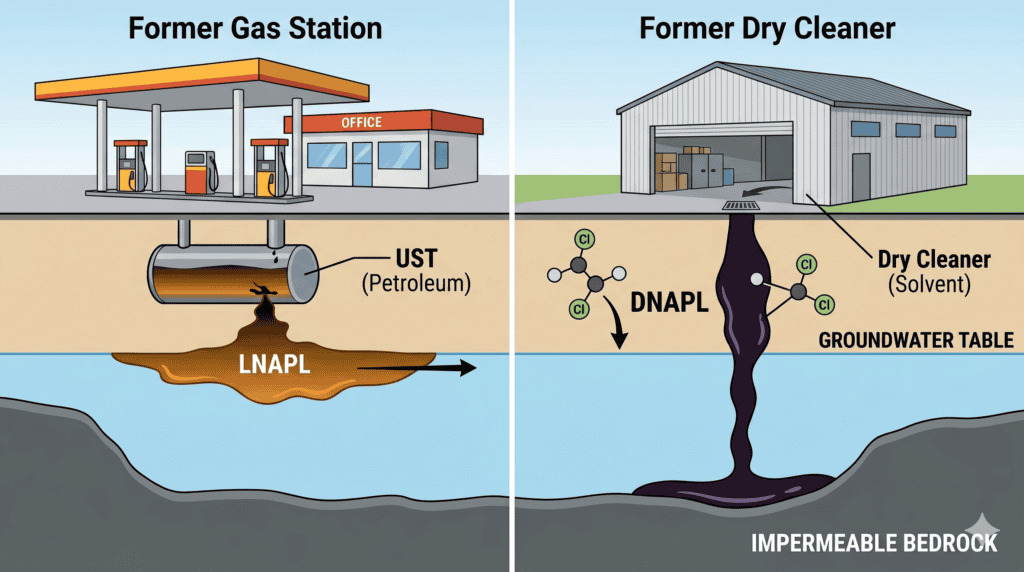
The historical use of a property determines the target chemical compounds, which in turn dictates the drilling methods, sample collection media, and laboratory analysis required. To illustrate why scopes cannot be standardized, consider how two common commercial archetypes require completely different investigative strategies:
1. The Former Dry Cleaner Site
Dry cleaning operations historically relied on chlorinated solvents, most notably tetrachloroethylene (PCE or “perc”).
- Contaminant Behavior: PCE is a Dense Non-Aqueous Phase Liquid (DNAPL). It is heavier than water and sinks rapidly through soil.
It easily penetrates concrete floors and moves deep into the underlying groundwater table.
Furthermore, PCE volatilizes readily into a gas. This gas can travel upward through soil pore spaces.
- The Phase II Scope: A proper investigation at a former dry cleaner cannot rely solely on shallow soil boring.
The scope must include deep soil sampling and groundwater monitoring well installation. It also requires a robust vapor intrusion assessment.
Soil vapor sampling or sub-slab soil gas testing is critical. It determines if toxic vapors are migrating into the indoor air, which poses a health risk to occupants.
2. The Historic Gas Station (Petroleum Storage)
Retail fuel properties handle gasoline, diesel, and waste oil. Operators store these liquids in Underground Storage Tanks (USTs).
- Contaminant Behavior: Petroleum hydrocarbons include BTEX (benzene, toluene, ethylbenzene, and xylenes). These chemicals are Light Non-Aqueous Phase Liquids (LNAPLs). They are lighter than water and tend to float on top of the groundwater table.
- The Phase II Scope: The investigation focuses heavily on source zones. These include UST basins, product piping runs, and fuel dispenser islands.
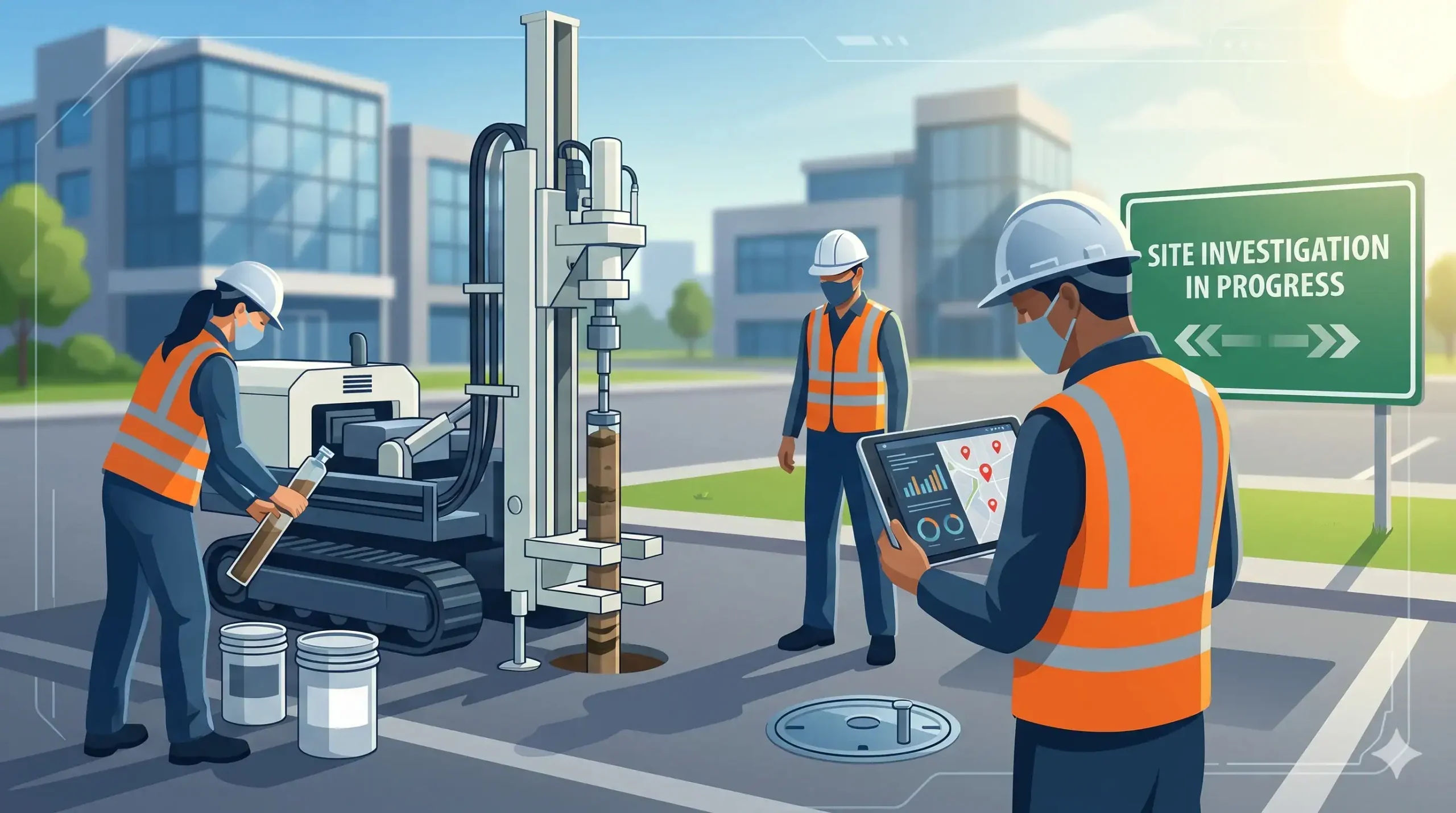
Field teams utilize direct-push drill rigs to collect soil cores and groundwater samples. They collect these right at the water table interface.
Crews still evaluate vapor pathways via petroleum vapor intrusion guidelines. However, the vertical migration pattern is entirely different from a chlorinated solvent plume.
Beyond Chemicals: The Impact of Local Geology and Hydrogeology
Two identical properties with the exact same historical use can require vastly different Phase II scopes. Physical location dictates everything. Soil composition and groundwater depth alter the engineering effort required to collect a sample.
Subsurface Variables and Field Adjustments
- Tight Clay Formations: Dense, low-permeability clays slow down groundwater movement. Collecting a true groundwater sample might require leaving a temporary monitoring well in place for 24 to 48 hours. This time allows enough water to seep into the well casing for collection.
- Coarse Sand and Gravel: In highly permeable sandy aquifers, contaminants can migrate rapidly over significant distances. The scope for these sites often requires a wider lateral footprint of soil borings to delineate how far a plume may have traveled off-site.
Because sandy soil lets water flow easily, groundwater contamination can spread over long distances in a very short time. The scope for these sites often requires a wider lateral footprint of soil borings. This footprint helps delineate how far a plume may have traveled off-site.
- Bedrock Penetration: Standard direct-push sampling probes cannot pierce deep bedrock layers.
If rock traps underground water, the testing plan must change. It must include heavy-duty rotary drill rigs capable of coring through rock. This equipment significantly impacts field timelines and budgets.
Understanding Soil and Groundwater Risks

As shown in the diagram above, underground layers vary wildly. Notice how loose sand sits right where groundwater collects, while tight layers like clay act as a barrier. When pollutants hit a loose, sandy layer, they move fast because there is very little resistance to slow them down.
Balancing Regulatory Standards and Transaction Goals
A defensible Phase II scope must align with local regulatory frameworks. For example, in Texas, state rules govern how professionals evaluate data.
The Texas Commission on Environmental Quality (TCEQ) sets these specific standards. They do this through the Texas Risk Reduction Program (TRRP). This program establishes the official state guidelines for environmental cleanup and safety.
Collected data must meet specific laboratory detection limits. This accuracy allows for a proper comparison against established regulatory screening levels.
A poorly designed scope might use the wrong analytical methods. If that happens, lenders or state regulators may reject the data. This error forces a costly re-sampling event.
Summary of Scope Variations

Summary of Scope Variations
To see how these variables interact, the table below contrasts how site history and physical conditions reshape the technical components of a Phase II scope of work:
The Technical Takeaway: A customized Phase II ESA scope of work protects your transaction by ensuring you do not overpay for unnecessary testing, while ensuring you do not inherit hidden environmental liabilities. By engineering the sampling plan around the specific geological and chemical realities of the asset, environmental professionals deliver the precise, defensible data required to satisfy commercial lenders and maintain clear regulatory compliance.
Frequently Asked Questions (FAQ)
Unlike a Phase I, timelines vary based on the scope. Fieldwork usually takes 1 to 3 days, but laboratory analysis and report writing can take 2 to 3 weeks. If your site has tight clay or deep bedrock, add extra time for sample collection.
A Phase II simply uncovers facts. Finding contamination can lower a property’s value.
It can also make it harder to get financing. However, knowing the risk early allows you to negotiate a lower price. You can also use that time to plan how to clean it up.
No, that is not the case. Even next-door neighbors can have different types of soil. They can also have different groundwater depths.
Finally, their properties may have entirely different histories of chemical use. Your scope must be unique to your parcel.
No, that is not the case. Even next-door neighbors can have different types of soil. They can also have different groundwater depths.
Finally, their properties may have entirely different histories of chemical use. Your scope must be unique to your parcel.
The SKA Environment Difference
SKA helps developers, investors, and property owners understand environmental findings. We deliver these insights early. This keeps pollution risks from hurting your construction, financing, or deal choices.
- Support for Phase I and Phase II environmental assessments
- Practical guidance on vapor-risk evaluation and next steps
- Clear reporting for developers, lenders, and property owners
- Experience across individual sites and multi-property portfolios
A customized Phase II ESA scope of work protects your transaction. No, environmental risks vary by property. Even next-door neighbors can have completely different soil types.
Local groundwater depths can also vary from one lot to the next. Finally, nearby properties often have entirely different histories of chemical use..
Act Today
Are you planning a Phase II assessment for your next commercial real estate deal? Do not rely on a generic template. Get in contact with SKA at info@skaenvironment.com to build a custom testing strategy for your asset.
Click here for more information on our Phase II offerings.